



If you’re moving into a new home, building a new house, or simply upgrading your entryway, you might find there is no existing doorbell — no wiring, no transformer, no chime. That doesn’t mean you can’t enjoy the convenience and security of having a modern video doorbell like a Ring device. Installing a Ring Doorbell from scratch (i.e., without pre‑existing doorbell wiring) is entirely possible — you just need to supply the appropriate transformer and wiring, or choose a battery-powered Ring model.
This guide explains why and when you’d want to install a Ring Doorbell without existing wiring (e.g. new build, no previous doorbell), and how to do it properly and safely.

In short — yes, you can install a Ring Doorbell without existing wiring. With the right transformer (or by choosing a battery-powered Ring doorbell), a bit of wiring, and some basic tools — you can set it up yourself, or with help from an electrician.
Below is a detailed, step‑by‑step guide on how to install your Ring Doorbell from scratch using a transformer.
Why Install a Ring Doorbell Without Existing Wiring?
- New home or renovation: Many newly built homes don’t come with doorbell wiring pre-installed. Installing a Ring now avoids later headaches.
- Upgrade your security: Even without prior wiring, you can still enjoy video doorbell features — real‑time alerts, video & audio, remote access.
- Avoid battery hassle (if wired): With a transformer, you won’t need to recharge or replace batteries. Reliable power means always-on readiness.
- Flexibility: Whether you choose a hardwired setup or a battery-powered option, Ring gives flexibility to fit different home situations.
Quick Answer: Can You Install a Ring Doorbell Without an Existing Doorbell?
Yes — you can. If your home has no prior doorbell wiring, you have two main options:
- Use a battery-powered Ring doorbell (runs on internal battery).
- Install a low‑voltage transformer + wiring + optionally a doorbell chime, then wire your Ring doorbell accordingly.
If you go for the second option, you’ll need to install a transformer, wire from it to the doorbell, and mount the doorbell properly.

How to Install Ring Doorbell Without Existing Doorbell (Using Transformer)
Choosing the Right Approach
When installing a Ring without existing wiring, you have two possible approaches:
- Battery‑powered Ring doorbell — simplest, requires no wiring or transformer.
- Hardwired Ring doorbell with new transformer and wiring — more work, but gives permanent power and avoids recharging.
Because you asked about installing “with Transformer,” we’ll focus on the hardwired method here.
What You’ll Need (Tools & Materials)
| Component / Tool | Purpose |
|---|---|
| Low‑voltage transformer (typically 16 VAC, 5–40 VA) | Converts mains voltage to safe doorbell voltage for Ring. |
| Low‑voltage doorbell wire (2‑core or bell wire) | To run power from transformer to doorbell unit |
| Junction box or transformer housing (if required) | For safe mounting of transformer if hardwired to mains. Some transformers are DIN‑rail mount. |
| Drill, masonry bit or wood drill bit (depending on wall) | To mount the Ring doorbell bracket on exterior wall or door frame |
| Screws / wall anchors | For mounting — anchors required if mounting on brick/concrete/stucco. |
| Wire nuts or connectors | For connecting wires securely |
| (Optional) Doorbell chime or chime kit | If you want audible chime inside house — otherwise rely on smartphone alerts |
Note: If you’re connecting transformer to your home’s mains electricity, this step should ideally be done by a qualified electrician for safety and compliance.
Step‑by‑Step Installation: Hardwired Ring Doorbell (No Existing Doorbell)
1. Select the Mounting Location
- Choose a spot at around chest height (about 1.2–1.4 m from ground) for best visibility and accessibility.
- Make sure the area is level and the surface is clean — mark the screw holes using the doorbell’s mounting bracket as a template.
2. Install Transformer and Run Power Wiring
2.1 Install Low‑Voltage Transformer
- Get a transformer rated for 8–24 VAC, 5–40 VA, compatible with Ring’s specifications.
- Mount the transformer near the house’s electrical panel or a junction box (or use a plug‑in transformer if allowed by local code). Some prefer mounting on DIN rail if using a hardwired transformer.
- Ensure the transformer is powered off before connecting anything.
2.2 Run Low‑Voltage Wire from Transformer to Doorbell Location
- Use proper 2‑core low-voltage “bell wire” or similar cable, sized as recommended by the transformer / manufacturer.
- Conceal the wire in wall cavity, conduit, or protective conduit as per local building codes (especially if exterior).
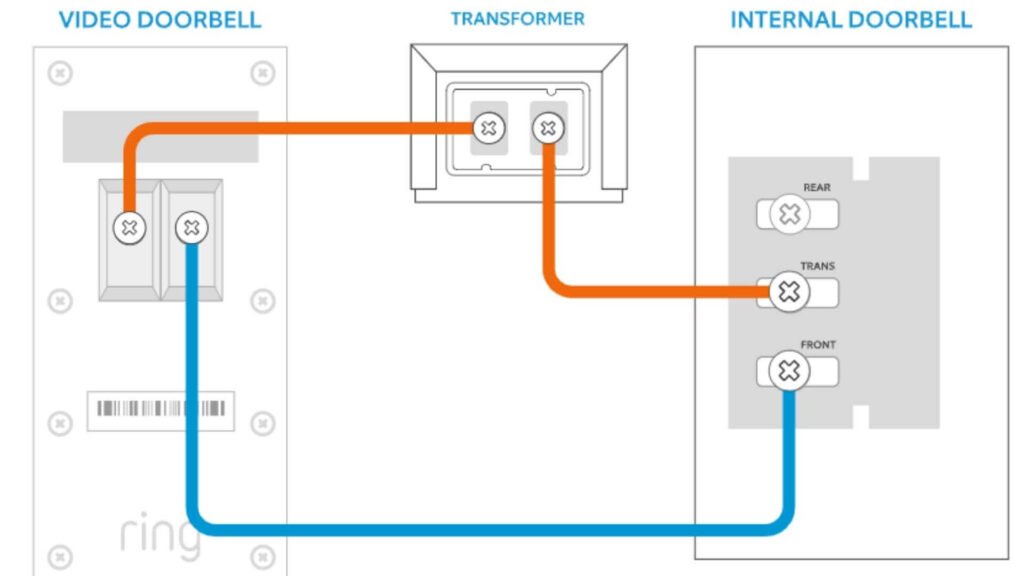
- At the doorbell location, use wire nuts/connectors to expose two low-voltage wires (usually “trans” / “front door” wires).
3. Connect Wiring to the Ring Doorbell
- On the back of your Ring doorbell, you’ll find two screw terminals — connect one wire to each screw. Ensure wires are not touching each other (to prevent short).
- Tighten screws snugly (but don’t over-tighten).
- If using a model like Ring Video Doorbell Pro, and you have no chime, you may need the “Pro Power Kit” (or recommended inline fuse / resistor) to ensure safe operation.
4. Mount the Doorbell to the Wall
- Attach the provided mounting bracket to the wall using screws and, if needed, wall anchors (for brick/concrete).
- After wiring is connected, mount the Ring doorbell onto its bracket, top first (camera on top), button on bottom.
- Secure the device with the security screw provided — this prevents theft or accidental removal.
5. (Optional) Install a Doorbell Chime or Chime Kit
- If you want a traditional “ding-dong” inside your house, install a doorbell chime (wired or plug-in). If you skip a chime, Ring will still notify you via smartphone app.
- Follow chime kit instructions: connect transformer to chime controller or module (if required) — especially for Pro or wired models.
6. Power On & Configure
- Restore power to the transformer.
- Open the Ring App on your phone and follow the in-app instructions to set up the doorbell — connect to Wi-Fi, name the device, test video and motion detection.
- Test button press to confirm it rings (via app or chime, if installed), verify video feed, and confirm stable power supply.
Alternative: Battery‑Powered Installation (No Transformer Needed)
If you prefer zero wiring, use a battery-powered Ring doorbell — this is the simplest method.
- Charge the internal battery fully.
- Mount the doorbell at desired location (about chest height), following the same bracket and screw/anchor steps as above.
- Use the Ring App to configure the doorbell (Wi-Fi, name, settings).
This is easiest for renters, new homes, or anyone who wants to avoid wiring — though you’ll need to recharge periodically (or wire it later to trickle-charge).
Key Considerations & Best Practices
Use Appropriate Voltage & Transformer
- Always use a transformer that outputs AC, 8–24 VAC, 5–40 VA (or as per your Ring model).
- If using a high-voltage mains supply (e.g. 220 V), you must step it down safely using a dedicated transformer and wiring kit.
Safety First — Electrical Work Should Be Done Properly
- If you are not confident working with electricity, hire a qualified electrician — especially for installing transformer and connecting to mains. Many communities recommend this for safety and code compliance.
- Use proper low-voltage wiring (not random mains cable), and protect wiring from weather, moisture, or tampering.
Chime vs. App Notifications
- If you want a traditional bell sound when someone presses the doorbell — install a wired or plug-in chime. Otherwise, the Ring App can notify you on your smartphone. Many users rely solely on app notifications.
- Note: for some Ring models (especially Pro), the chime “module” or “power kit” may be mandatory when wiring directly to a transformer, even if you don’t have an existing chime.
Wi‑Fi & Positioning for Best Performance
- Mounting height should allow a good view of whoever approaches — typically around chest height.
- Ensure your Wi‑Fi signal is strong at the doorbell location. Weak signal leads to video lag or missed motion detection.
FAQs — Common Questions About Installing Ring Doorbell Without Existing Doorbell
Can I install Ring doorbell if my house has never had a doorbell before?
Yes — either use a battery-powered Ring doorbell or install a transformer + wiring + mount a wired Ring. Both options work.
What type of transformer do I need for a Ring doorbell?
Use a low-voltage transformer outputting 8–24 VAC and 5–40 VA (or per Ring’s specifications).
Do I need a doorbell chime to use a Ring doorbell?
No. A chime is optional — Ring will still send notifications to your phone when the doorbell button is pressed.
Can I connect the Ring transformer directly to mains 220 V supply?
Yes — but only by using a proper transformer that steps down to low-voltage AC. Better to have a qualified electrician install this safely.
Is battery-powered Ring better than hardwired?
It’s simpler to install and avoids wiring, but you’ll need to recharge periodically. Hardwired gives continuous power, no recharging, and more “set-and-forget.”
I have a wired Ring doorbell but no chime — will it still work?
Yes, but for some models (e.g. Pro) Ring may require a “Power Kit” or inline resistor to ensure safe operation when no chime is present.
How high should I mount the Ring doorbell on my wall?
Typically around chest height — about 1.2 to 1.4 meters from ground for best visibility and usability.
Can I do the installation myself or should I hire an electrician?
If you have basic electrical knowledge, you can do it. But for transformer wiring, mains connection, or running wires through walls — it’s safer and often advisable to hire a qualified electrician.
What if my transformer output is too high (e.g. 24 VAC) — will it damage Ring?
Some Ring wired models accept up to 24 VAC, but many people recommend using the standard 16 VAC transformer or the transformer recommended by Ring to avoid risk.
Summary
Installing a Ring Doorbell without existing doorbell wiring — including no transformer or chime — is very much possible. You have two realistic choices: go with a battery-powered Ring for a quick, wiring-free solution; or install a low-voltage transformer, run proper wiring, and hardwire your Ring doorbell for a permanent setup.
While the battery option is easiest and fastest (ideal for renters or new builds), the hardwired option offers long-term convenience — no recharging, always‑on power, and a more “professional” doorbell setup. Whichever route you choose, follow proper wiring practices, use correct transformer and cable, and — when in doubt — consider hiring an electrician to ensure safety and compliance.
With careful planning and correct installation, you can enjoy all the benefits of a modern Ring Doorbell even if your home never had one before — greater security, remote alerts, and peace of mind.