

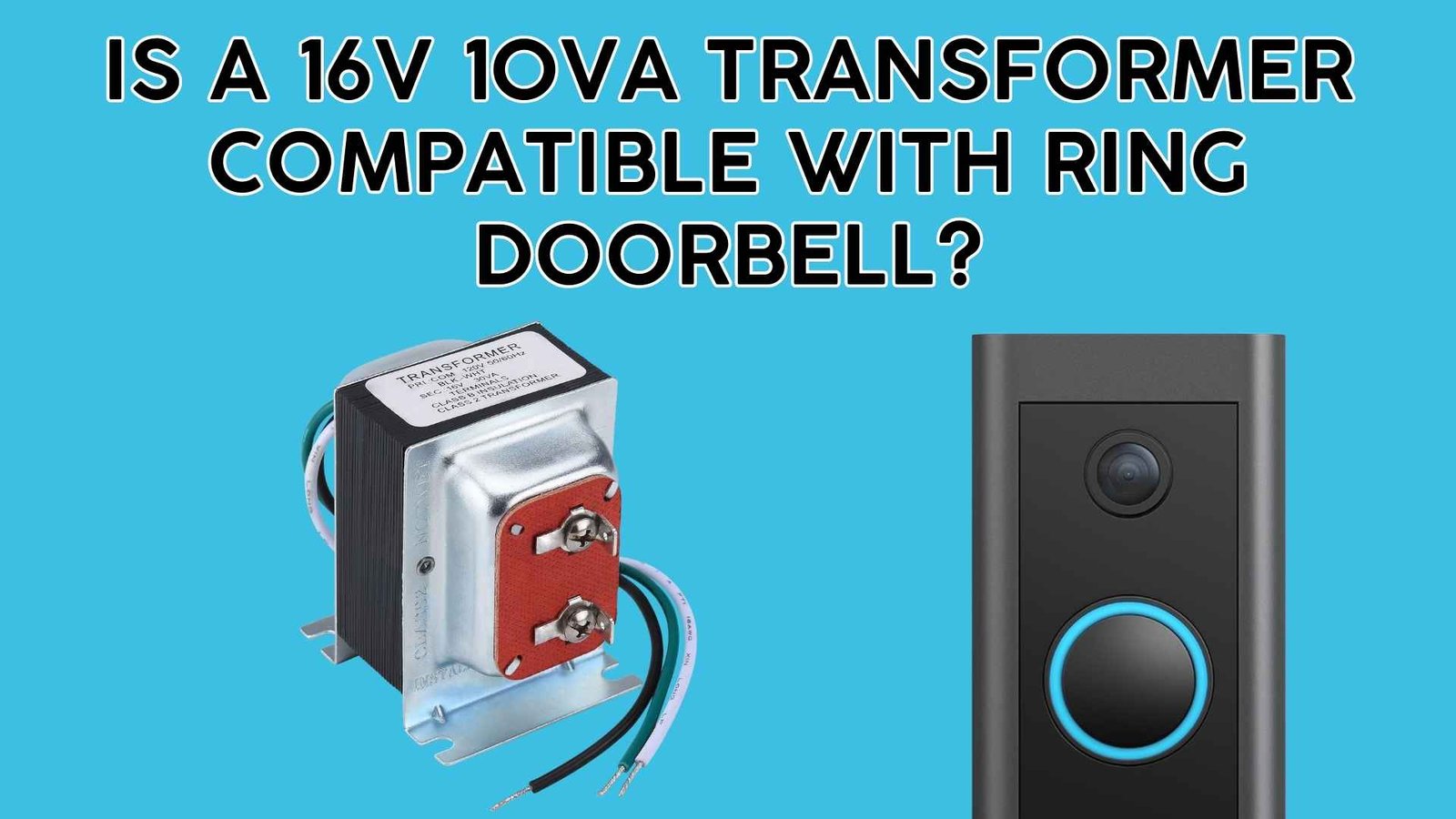

Doorbell transformers are the “hidden power supply” behind a hardwired (or semi-hardwired) Ring doorbell. If the transformer is underpowered, your Ring may show “poor” voltage in Device Health, miss events, reboot, lose night vision reliability, or fail to keep the battery topped off. If it’s over the supported range, you risk device damage and safety issues. That’s why homeowners (and DIY installers) in the U.S. should understand whether a 16-volt, 10-VA transformer is truly compatible before installing or troubleshooting.
A 16V, 10VA doorbell transformer is sometimes compatible with Ring doorbells, but it depends on the model and your setup. Voltage-wise, 16VAC is usually within Ring’s supported range for many devices. Power-wise, 10VA is the minimum for some wired/pro models and may be unreliable if you have long wiring runs, an internal chime, or a power-hungry model. Ring commonly recommends higher VA (often 30–40VA) for best performance on certain wired models.
16V 10VA Doorbell Transformer Compatibility With Ring Doorbell
Before you decide “yes” or “no,” confirm you’re reading the transformer label correctly:
- VAC (Volts AC) = the output voltage (example: 16VAC)
- VA (Volt-Amps) = the transformer’s power capacity (example: 10VA)
VA is a power rating (apparent power in AC systems). In simple terms, higher VA = more available current for your doorbell and chime.
VAC vs VA (why people mix up “10 VAC”)
Many people say “10 vac” when they actually mean 10 VA. Most doorbell transformers are labeled something like 16VAC / 10VA. A transformer that truly outputs 10VAC (ten volts) is different and may not meet Ring’s minimum requirements for several models. Ring publishes requirements using VAC and VA ranges, so it’s important to match both.
Ring’s official hardwired power ranges (quick reference)
Ring provides transformer compatibility ranges by doorbell type/model category. Here are the key ranges from Ring’s official hardwiring guidance:
| Ring doorbell category (hardwired) | Supported transformer range (Ring) | Where 16VAC / 10VA lands |
|---|---|---|
| Ring battery doorbells + Video Doorbell Elite | 8–24 VAC, 50/60Hz, 5–40VA | ✅ Within range |
| Video Doorbell Wired | 10–24 VAC, 50/60Hz, 8–40VA | ✅ Within range |
| Video Doorbell Pro / Wired Video Doorbell Pro / Wired Doorbell Plus (2nd Gen) | 16–24 VAC, 50/60Hz, 10–40VA | ✅ Bare minimum |
| Wired Doorbell Pro (3rd Gen) | 16–24 VAC, 50/60Hz, 10–40VA | ✅ Bare minimum |
Bottom line from the table: a 16VAC/10VA transformer can be “compatible on paper” for many Ring models—but it may not be the best choice for consistent performance, especially on higher-end wired models.
Is 10VA Enough Power for a Ring Doorbell?
A transformer’s VA rating tells you how much current it can supply at the rated voltage. You can approximate available current like this:
Amps ≈ VA ÷ Volts
Example: 10VA ÷ 16V ≈ 0.625A
That’s not a perfect real-world measure (AC loads vary), but it explains the practical issue: 10VA is a low ceiling for a modern smart doorbell that’s streaming video, running Wi-Fi, and sometimes powering a chime circuit.
When a 16V 10VA transformer usually works fine
A 16VAC/10VA transformer is more likely to be “good enough” when:
- You have a Ring battery doorbell that is only trickle-charging from the wires
- Your wiring run is short and in good shape
- You don’t have a complex internal chime setup drawing extra current
- You’re not seeing power warnings in the Ring app
Ring’s compatibility ranges for battery doorbells allow down to 5VA, which is why many battery models tolerate modest transformers better.
When a 16V 10VA transformer becomes a problem
You’re more likely to run into issues if you have:
- A wired-only Ring model (or a “Pro” model) that draws more continuous power
- A mechanical or digital chime on the same transformer
- Long wire runs, thin/old wiring, or loose connections (voltage drop)
- Cold-weather performance demands (more load, more voltage sensitivity)
Ring even notes that some wired models perform best with more headroom. For example, Ring’s Wired Doorbell Pro (3rd Gen) product details state 16–24VAC, 10–40VA, with 30–40VA recommended for optimal performance.
Signs Your Transformer Is Underpowered (common Ring symptoms)
If your Ring is installed and power is borderline, you may notice:
- “Transformer Voltage: Poor” or other power warnings in Device Health
- Random reboots or the doorbell going offline during motion events
- Delayed notifications or missed recordings
- Weak or inconsistent night vision / IR performance
- Chime buzzing/humming or chime not ringing reliably
- Battery not maintaining charge (on battery models connected to wiring)
If you see these, the transformer may technically be “compatible,” but not sufficient for stable real-world performance.
How to Confirm Your Doorbell Transformer Rating (fast checklist)
Step 1: Find the transformer label
In most U.S. homes, the doorbell transformer is commonly located:
- Near the electrical panel (basement/garage/utility room)
- On or near a junction box
- In an attic crawl space (older homes)
- Near the chime box (sometimes)
Look for stamped text such as: 16VAC 10VA.
Step 2: Match your Ring model to Ring’s published ranges
Use Ring’s hardwiring guidance table (above) to check both:
- Voltage range (VAC)
- Power capacity (VA)
If your transformer sits at the minimum edge (like 10VA), expect “works, but not always great,” especially for Pro-class wired devices.
Best Transformer Options If You Need an Upgrade
If you’re replacing a weak transformer, two common “sweet spot” upgrades are:
1) 16VAC, 30VA (very common Ring-friendly upgrade)
Ring sells a hardwired transformer designed as a drop-in replacement in North America with 16V AC at 30VA output—exactly the kind of upgrade that typically solves borderline power issues.
Who it’s best for
- Most Ring setups that are currently running 16V 10VA
- Homes with an internal chime and typical wiring distances
2) 24VAC, 30–40VA (more headroom; often ideal for power-hungry setups)
Many wired smart doorbells perform well with 24VAC systems (as long as the device supports 24VAC). Ring’s wired/pro devices are commonly specified up to 24VAC with VA within the allowed range.
Who it’s best for
- Long wiring runs
- Multiple chimes/devices on the same transformer
- Users who want maximum stability and fewer “power required” feature limits
Short safety note (worth taking seriously): Ring warns that using incompatible power sources can damage the device and pose an electric shock risk.
Chime, Wiring, and “Real-World Compatibility” (what specs don’t tell you)
Even if your transformer matches the official minimums, these factors can make 10VA behave like “not enough.”
Mechanical vs digital chimes
A traditional mechanical chime may draw a burst of current when rung. A digital chime can have different load behavior. Either way, adding a chime increases demands on the transformer—so extra VA headroom helps.
Wiring length and voltage drop
Longer runs and older/thinner wiring can reduce delivered voltage at the doorbell, especially under load. If your Ring reports “poor voltage” while the transformer label looks correct, upgrading VA is often the simplest fix.
Model-specific performance recommendations
Even where Ring lists 10–40VA compatibility, Ring may also recommend higher VA for best performance on certain models (like recommending 30–40VA).
Practical Decision Guide: Should You Use a 16V 10VA Transformer?
✅ You can usually keep a 16V 10VA transformer if…
- Your Ring model is a battery doorbell using wiring mainly for trickle charge
- Device Health shows good voltage and you have no power-related problems
- Your chime setup is simple (or you don’t use a chime)
⚠️ You should strongly consider upgrading if…
- You have a wired pro-class model (or want the most stable performance)
- Your Ring shows “poor voltage” or features complain about power
- You have a chime + long/old wiring
- You’re troubleshooting random disconnects or missed events
FAQ: 16V 10VA Transformer and Ring Doorbell Power
1) Will a 16V 10VA transformer damage my Ring doorbell?
Usually, no—low VA is more likely to cause instability than damage. But you should stay within Ring’s supported VAC/VA ranges for safety and reliability.
2) Is 16 volts the “right” voltage for Ring?
For many Ring doorbells, 16VAC is within the supported range, especially for Pro/wired models that specify 16–24VAC.
3) What’s the difference between 10VA and 30VA for a transformer?
VA is power capacity. A higher VA transformer can supply more current without voltage sag, improving stability and reducing power warnings.
4) My transformer is 16VAC but Ring says “poor voltage.” Why?
Common causes are low VA, long wiring runs, loose connections, or a chime drawing extra current. Upgrading to 30–40VA often helps.
5) What transformer does Ring recommend in North America?
Ring sells a hardwired transformer rated 16V AC at 30VA as a drop-in replacement for many North American doorbell transformers.
6) Can I use a higher VA transformer than required?
In most doorbell transformer scenarios, more VA (within spec) is fine—the device draws what it needs. The important part is staying within Ring’s supported ranges.
7) Do wired Ring “Pro” models need more power than battery models?
Generally yes. Battery models can run mostly on their battery (wires help trickle charge), while wired models depend on continuous power—so low VA is more likely to cause issues.
8) What is the minimum VA for Ring Video Doorbell Wired?
Ring lists 8VA to 40VA for Video Doorbell Wired (with the voltage range specified as 10–24VAC in its hardwiring guidance).
9) If my transformer label says “16V 10VA,” is that the same as “16V 10VAC”?
“16V” typically means 16VAC output. “10VA” is the power rating. People often mis-say “10VAC,” but the correct unit for capacity is VA, not VAC.
10) What’s the “best all-around” transformer spec for most Ring installs?
For many U.S. homes, 16VAC 30VA is a very common, stable upgrade. Some models recommend 30–40VA for optimal performance.
Summary
A 16-volt, 10-VA doorbell transformer can be compatible with certain Ring doorbells, especially battery models and some wired devices—but it’s often the bare minimum and may cause power warnings or unreliable performance depending on your model, chime, and wiring. If you want fewer headaches, Ring’s own guidance and product specs point toward more headroom (often 30–40VA) for optimal stability—especially on higher-end wired/pro models.